
When a medical emergency happens, everything can feel overwhelming — especially when you may be far from advanced care. For MASA Assist members, our support starts with one phone call. But what happens next is a carefully coordinated process that most people never see.
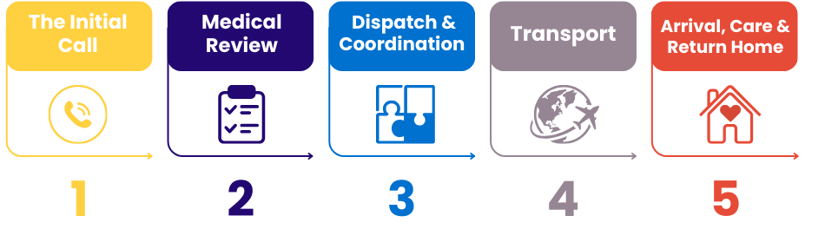
Here’s a lookbehind the scenes at a typical “day in the life” of MASA emergency air and ground transport coordination, and how it all comes together when it matters most.
Step 1: The call that starts it all
Everything begins the moment a MASA Assist member or family member calls us at (800) 643-9023 or (817) 430-4655. That call is answered by trained coordinators who know how to act quickly and calmly.
They gather essential information:
• Where the patient is located
• The medical situation and current condition
• Which facility the patient is at (or nearest to)
• Who the attending physician is
From the very first minutes, the focus is on medical need, not paperwork.
Step 2: Doctor to doctor medical review
One of the most important things MASA Assist members should know: Transport decisions are made by physicians, not insurance adjusters.
MASA’s Medical Director works directly with the attending doctor to determine:
• Is specialized care needed that isn’t available locally?
• Is the patient stable enough for transport?
• What level of transport is medically appropriate?
This doctor-to-doctor conversation ensures the decision is based on what’s best for the patient — not cost, not convenience, and not delays.
Step 3: Dispatch & coordination
Once transport is approved, coordination moves fast.
MASA Assist arranges:
• The appropriate aircraft or ground ambulance
• A medical crew suited to the patient’s condition
• Required clearances, flight plans, and logistics
• Ground transport on both ends of the journey
• Accompanying travel plans for a companion (if included in your plan)
• Return transport plans for minor children, pets, or vehicles (if included in your plan)
In the Caribbean, this often means coordinating across islands, countries, airports, hospitals, and time zones — all behind the scenes, so families don’t have to.
Step 4: The transport
During transport, the patient is continuously monitored by experienced medical professionals. Communication stays open between:
• The transport medical team
• Sending and receiving facilities
• MASA’s Member Services team
Families are kept informed, so they know where their loved one is and what to expect next.
Step 5: Arrival, care & the journey home
Once the patient arrives at the receiving facility, care is seamlessly transferred. MASA will continue to assist with coordination as recovery progresses.
When the time is right and the patient is medically cleared, MASA Assist can also help arrange the journey home, completing the full circle of care.
Carefully coordinated, every step of the way
What may feel like chaos during an emergency is, behind the scenes, a carefully managed process built on experience, medical judgment, and coordination.
For MASA members, that means peace of mind—knowing that in a critical moment, decisions are guided by doctors, logistics are handled by experts, and you’re never navigating it alone.
MASA is always there—quietly working in the background—so you and your family can focus on what matters most: health and recovery.